A well-chosen rug does something no piece of furniture can: it unites everything else. It softens sound, adds a thermal layer to cold floors, and visually anchors the bed, nightstands, and surrounding pieces into a composition that feels deliberate rather than assembled by accident.
This guide covers the rug styles that actually create coziness, the materials worth understanding before you buy, how to get placement right, and the sizing rules that separate a thoughtful bedroom from one that just has furniture in it.
Key Takeaways
- A rug anchors the room's visual composition — furniture without one reads as unfinished, regardless of quality
- Material determines how cozy a rug feels — pattern and color come second
- Size for exposure: extend any under-bed rug at least 18–24 inches past the bed's sides
- Start with an 8×10 or 9×12 for queen and king beds — then size up if the room calls for it
- When in doubt, go larger — an undersized rug disappears; a well-proportioned one defines the space
Why the Right Rug Sets the Mood for Your Entire Bedroom
A bedroom rug is a structural element of the room's design — one that shapes how the space sounds, feels underfoot, and registers visually the moment you step inside.
According to Architectural Digest, a correctly sized area rug grounds a space, anchors furniture, defines areas, and adds comfort and warmth. Four distinct functions from a single purchase — which is why the rug decision carries more weight than most people give it.
The Zone Effect
Without a rug, a bedroom's furniture tends to float. The bed sits in the middle of the floor, the nightstands flank it, and the whole arrangement looks like a showroom rather than a room someone actually lives in. A rug beneath the bed pulls those pieces together into a single visual unit — the sleeping zone — and gives the entire composition a base to rest on.
This matters most in rooms where the furniture has refined proportions. A bed frame with clean silhouettes and considered geometry reads much better against a well-proportioned rug beneath it. The rug doesn't compete; it lets the frame register properly.
Upholstered bed frames with restrained, Italian-inspired forms — like those in Garofano's bedroom collection — pair naturally with rugs that honor those proportions, neither disappearing beneath the bed nor crowding the floor plan.
Connecting the Room's Design Elements
A rug shouldn't be chosen in isolation. The most coherent bedrooms treat it as a connector — either picking up a color already present in the bedding, echoing a material tone from the furniture, or introducing a deliberate contrast that adds depth. That connection is what separates a rug that was "placed" from a bedroom that was actually designed.
Best Rug Styles for a Cozy Bedroom Atmosphere
Different styles serve different rooms. Here's how each one works in practice:
Plush and High-Pile Rugs
The fastest route to tactile coziness. Stepping barefoot onto a deep, soft pile after waking is a specific sensory pleasure, and it's worth designing for.
High-pile rugs work especially well in:
- Minimalist bedrooms where softness counterbalances hard furniture
- Rooms with hardwood floors that need visual warmth
- Neutral color schemes where a cream, ivory, or warm white rug adds texture without visual noise
The trade-off: higher pile traps more dust and requires more maintenance. Synthetic high-pile options offer a practical middle ground, delivering comparable softness with easier care for everyday use.
Natural Fiber and Textured Rugs
Jute, sisal, and wool bring organic warmth and grounding texture. They work particularly well in spaces with rustic wooden furniture, earthy palettes, or Scandinavian and transitional design sensibilities.
Material distinctions:
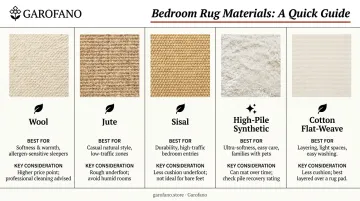
- Jute is softer than sisal and suited to bedroom environments, but moisture-sensitive — avoid humid rooms
- Sisal is among the most durable natural fibers, though its coarser texture offers less softness underfoot
- Wool provides natural insulation and sound absorption, making it one of the most complete bedroom rug materials available
The International Wool Textile Organisation confirms that wool flooring dampens and absorbs sound across frequency ranges — a real benefit in rooms designed for rest.
Vintage and Persian-Inspired Rugs
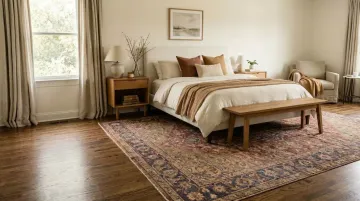
A vintage or Persian-style rug brings the one thing a new rug rarely can: character. Layered pattern, slightly worn edges, and a sense of history genuinely animate bedrooms with simple or neutral furniture.
The design principle here is that the rug leads. Choose a vintage rug you love, then build the rest of the room's textile palette (bedding, cushions, throw) around the colors already present in it. It's one of the most reliable ways to create a bedroom that feels collected rather than decorated.
Geometric and Pattern-Forward Rugs
Modern, contemporary, and transitional bedrooms respond well to geometric rugs: they deliver visual interest without the density of traditional patterns. A two-tone geometric in navy and cream, or charcoal and ivory, can define the sleeping zone strongly while keeping the room feeling ordered.
Architectural Digest notes that a bold geometric rug introduces lines and movement that guide the eye through the room, useful when you want a rug to do compositional work rather than simply fill the floor.
Geometric rugs work best when:
- The room's furniture is understated and benefits from a focal point at floor level
- You want to zone the sleeping area without adding a physical partition
- The palette is limited to two or three tones
Garofano's geometric designs — including the Sereno with its contrasting ribbed stripes and the Oriente with arched motifs — apply exactly this principle.
Layered Rugs for Depth and Dimension
Layering is a technique designers use to add material depth and a collected quality to larger bedrooms. The approach: place a smaller, textured or patterned rug over a larger neutral base.
A documented example from House Beautiful features designer Amity Worrel layering flat-weave jute beneath high-pile shearling in a cream bedroom, combining structural coverage with softness across two complementary materials. The result has more visual interest than either rug alone.
Layering works best when:
- The base rug is larger and neutral (jute, sisal, or a solid wool)
- The top rug introduces pattern, texture, or color
- Doors remain clear and edges are secured to prevent trip hazards
How to Choose the Right Rug Material for Warmth and Comfort
Pattern and color are what you notice from across the room. Material is what you feel the moment your feet hit the floor. Get the material wrong and no amount of great styling fixes it.
Core Material Categories
| Material | Best For | Consideration |
|---|---|---|
| Wool | All-around bedroom use; insulation, acoustics, durability | Higher price point; ages beautifully |
| Jute | Low-traffic zones; earthy aesthetics | Moisture-sensitive; avoid damp rooms |
| Sisal | Durability-focused choices; texture-forward design | Coarser underfoot than jute |
| High-pile synthetic | Everyday softness; easier maintenance | Less premium feel than natural fibers |
| Cotton flat-weave | Layering; warmer climates; washability | Lighter weight; less insulating |
Pile Height: A Practical Guide
According to Jaipur Rugs, the standard thresholds are:
- Low pile: under 0.25 inch
- Medium pile: 0.25–0.5 inch
- High pile: over 0.5 inch
Low pile suits minimalist and formal bedrooms. It lays flat near doors, doesn't bunch underfoot, and cleans up easily. High pile is the cozier choice — noticeably softer underfoot, though it needs more upkeep. In a bedroom used gently, that tradeoff makes sense.
Don't Skip the Rug Pad
A quality pad underneath any bedroom rug prevents slipping on hard floors, adds real cushioning, and reduces friction that gradually wears the fibers down from below. Mohawk Home confirms that pads prevent pile crush and traffic-wear patterns over time. On hardwood, that protection matters most for wool or natural-fiber rugs.
Bedroom Rug Placement Ideas That Work
Placement determines whether a rug anchors a room or just occupies it.
Under-Bed Placement (Classic)
The most cohesive option. The rug extends beneath the bed and out on all three exposed sides, pulling the entire sleeping area into a unified composition.
On sizing: Pottery Barn recommends extending the rug 18–24 inches beyond the bed's exposed edges; Architectural Digest suggests at least 2 feet. The underlying principle is consistent — enough rug should be visible to read as deliberate.
This placement also draws the eye upward to the bed frame as the room's centerpiece. Beds with refined proportions and clean silhouettes, like those in Garofano's Letti collection, read particularly well against a well-scaled rug beneath them.
Flanking Placement (Alternative)
Two matching runner-sized or accent rugs placed symmetrically on either side of the bed. This approach:
- Preserves beautiful hardwood floors without covering them entirely
- Delivers softness exactly where it matters most (your first steps in the morning)
- Works well in smaller bedrooms or rooms where the floor is a design feature
Layered or Collage Arrangement (Creative)
Multiple smaller rugs arranged intentionally around the bed. Best suited to eclectic, bohemian, or maximalist bedrooms. Keep doors clear, anchor edges securely, and treat the arrangement as a composition — not a collection of rugs that happened to land there.
Choosing the Right Rug Size for Your Bedroom
Sizing too small is the most common bedroom rug mistake. A rug that floats in the center of the room without reaching any furniture legs reads as an afterthought.
Size by Bed Type
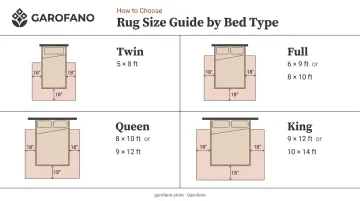
| Bed Size | Recommended Rug Size |
|---|---|
| King | 9×12 (standard); 10×14 or larger for full-coverage in generous rooms |
| Queen | 8×10 or 9×12 |
| Full | 6×9 or 8×10 |
| Twin | 5×8 |
The guiding principle: the rug should extend at least 18 inches on all visible sides of the bed. In larger master suites, a 9×12 keeps the rug from disappearing in the scale of the room. If the choice is between two sizes, default to the larger one.
Bed size is only part of the equation. The shape of the room itself often determines which rug format actually works.
Room Shape Considerations
- Long, narrow bedrooms: A runner at the foot of the bed or alongside one side often works better than a square area rug
- Square rooms: A centered area rug creates symmetry that runners can't replicate alone
- Large open-plan suites: Layer a larger base rug with a smaller accent rug to define the sleeping zone
Bedroom Rug Trends Worth Knowing
House Beautiful's 2025 expert survey identifies several clear directions in residential rug design:
- Warm neutrals — beige, warm white, soft stone tones dominating new collections
- Chunkier, higher piles — dimensional texture becoming a design feature rather than a functional afterthought
- Natural fibers — jute, 100% wool, and recycled materials gaining preference over synthetics
- Handcrafted character — slightly irregular textures and visible craft over machine-made uniformity
- Distressed Persian-style rugs — softer, aged patterns returning as statement pieces
Each of these directions points toward the same buyer instinct: choosing a rug that reads as considered rather than convenient. Garofano's rug collection maps closely to this: the Atlas brings earthy tones and natural materials; the Pietra and Calma offer high-low weave textures in wool-cotton-silk construction; the Sereno and Oriente carry architectural geometric patterns that hold their own as statement pieces.
Rug layering over wall-to-wall carpet or larger neutral base rugs is also mainstream — a technique that started in high-end residential design and has since crossed into everyday practice.
Frequently Asked Questions
What kinds of rugs look best in a bedroom?
Soft, high-pile or tufted rugs excel for pure coziness, while natural fiber rugs like wool or jute suit more design-forward spaces. The best choice depends on your room's existing palette, furniture style, and how much tactile warmth you want underfoot each morning.
What are some good rug ideas for a small bedroom?
Choose lighter colors to keep the space feeling open, and consider two smaller rugs flanking the bed rather than one large rug that crowds the floor. Low-pile options work better in compact rooms — high pile can make a small space feel visually heavier than it is.
What are some creative ways to lay out a bedroom rug?
Three approaches work well in most bedrooms:
- Under-bed anchor — the most cohesive option, with the rug extending out on both sides
- Flanking runners — two smaller rugs placed on either side of the bed
- Layered collage — multiple rugs of varying sizes and textures arranged intentionally around the bed
What are the latest trends in bedroom rugs?
Natural materials and warm neutral tones lead the current moment, alongside handcrafted or slightly irregular textures, rug layering over carpets, and the return of distressed Persian-inspired rugs as statement pieces.
How big should a bedroom rug be?
For king beds, start at 9×12; for queen beds, 8×10 or 9×12; for full and twin beds, 5×8 or 6×9. The rule of thumb: the rug should extend at least 18 inches past each exposed side of the bed.
Should a bedroom rug go under the bed?
Yes — placing the rug partially beneath the bed is the most common and cohesive approach. It anchors the room and creates a soft landing on both sides, so long as enough rug extends out to feel intentional rather than incidental.