Getting large rug sizing right is one of the highest-impact decisions in a room's design. The rug anchors the entire furniture arrangement — it defines the zone, sets the visual weight, and determines whether the room reads as cohesive or chaotic.
This guide covers exactly what dimensions qualify as "large," which standard sizes are available in 2026, and how to select the right size for every room type.
Key Takeaways
- Large rugs start at 8x10 ft (244x305 cm); the 8x10, 9x12, and 10x14 are the most widely stocked standard sizes
- A rug that's too small fragments a room — when in doubt, size up
- Measure the furniture grouping first, then size up to the nearest standard dimension
- Leave 18–24 inches of bare floor between the rug edge and the wall
- Custom and oversized sizes suit grand rooms, open-plan layouts, and hospitality projects
What Counts as a "Large" Rug?
Rug size terminology — "large," "extra-large," "oversized" — is applied inconsistently across retailers. There's no industry standards body that defines these categories. For practical purposes, this guide uses the following working definitions:
- Large rugs: 8x10 ft and above (the threshold used by major retailers including Rugs Direct)
- Oversized: 12x15 ft and above (Crate & Barrel applies "oversized" at this point, while Rugs Direct still categorizes 12x15 as "large")
- Extended/palace-scale: 12x18 ft and beyond — specialty or custom territory
Always verify exact dimensions in feet and inches — a rug labeled "large" at one retailer may be the same size as one labeled "oversized" elsewhere. That distinction matters most when you're sizing for a specific furniture grouping.
Why Scale Matters in Design-Led Interiors
In premium residential interiors, proportion is the organizing principle. A rug too small beneath a substantial furniture grouping disrupts the room's visual balance the way any out-of-scale piece would. The rug's dimensions should respond to the furniture's footprint — not to available floor space, and not to what's easiest to source.
For rooms with significant visual weight — a deep sectional, a large dining table, a king bed with substantial side tables — the rug needs to anchor that weight. A few key principles guide the decision:
- Match the furniture's footprint, not the room's square footage
- Front legs on, back legs off is the standard for seating groups; all legs on for dining
- One size up from your first instinct is usually correct in rooms above 300 sq ft
Standard Large Rug Dimensions: The 2026 Size Reference
Commonly Available Large Rug Sizes (8x10 to 12x15)
The table below covers all mainstream large rug sizes, with exact metric conversions based on NIST's definition of 1 foot = 30.48 cm.
| Nominal Size | Exact Dimensions (cm) | Typical Room Application |
|---|---|---|
| 8x10 ft | 243.84 x 304.80 cm | Medium-to-large living rooms, Queen bedroom full grouping |
| 9x12 ft | 274.32 x 365.76 cm | Larger living rooms, 6-seat dining, King bedroom |
| 10x14 ft | 304.80 x 426.72 cm | Open-plan zones, large living, 8-seat dining |
| 12x15 ft | 365.76 x 457.20 cm | Great rooms, formal dining, expansive primary suites |
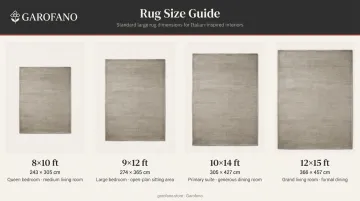
The 8x10 is the most broadly stocked size across mainstream and premium retailers. The 9x12 and 10x14 serve larger furniture arrangements and open-plan configurations. At 12x15, the categories begin to shift — Rugs Direct calls it "large," Crate & Barrel calls it "oversized" — but it's still available off the shelf from multiple retailers.
Extended and Oversized Large Rug Sizes
Beyond 12x15, sizing becomes more specialized:
- 12x18 ft (365.76 x 548.64 cm): Actively cataloged by specialist retailers like Rugs Direct; less broadly stocked than 12x15
- 14x20 ft (426.72 x 609.60 cm): Specialty and inventory-dependent — category pages exist at Home Depot but product availability varies
- Palace-scale (20+ ft): Available through bespoke manufacturers and antique dealers; not a standard retail category
Handmade and antique rugs can deviate from their labeled dimensions. Jaipur Living, for example, states that its handcrafted rugs may vary by up to +/-3 inches in finished size. For made-to-order rugs, always confirm exact finished dimensions before placing the order.
Room-by-Room Guide to Large Rug Sizing
The "right" large rug size is always relative to the room's furniture configuration. The same 9x12 that anchors a mid-size living room may be undersized in a grand open-plan space.
Living Room
For most large living rooms, the choice falls between 8x10 and 9x12 ft. The rug should extend at least 6–8 inches beyond the sofa on both sides, and ideally bring all major seating — sofa, chairs, and coffee table — within its perimeter.
Leg placement options — and consistency between them — matter as much as rug size:
- All furniture legs fully on the rug
- Front legs on, back legs off (works for most standard sofa depths)
- Never mix: some pieces fully on, others only partially reads as unresolved
For furniture of significant visual weight, the rug's scale should match. A deep, wide sofa paired with a 5x8 rug doesn't just look wrong proportionally — it makes the room feel smaller.
Dining Room
Dining room rugs need enough clearance for chairs to be pulled out without the rear legs falling off the rug edge. The required extension beyond the table:
- Minimum: 24 inches per side (per Rugs Direct guidance)
- Recommended: 36 inches per side (per Architectural Digest)
Practical size mapping:
- 6-seat table (60–72 inches): 8x10 ft
- 8-seat table (72–96 inches): 9x12 ft
For dining rooms, flatweave or low-pile constructions allow chairs to slide smoothly and simplify maintenance — a practical choice worth prioritizing alongside aesthetics.
Primary Bedroom
Size by bed:
- Queen bed: 8x10 ft minimum
- King bed: 9x12 ft minimum
The rug should extend at least 18–24 inches on each exposed side so occupants step onto the rug when getting out of bed. Placing the rug slightly forward of the bedside tables — rather than running beneath them — preserves visual proportion and openness in the room.
Open-Plan and Formal Spaces
Open-plan layouts generally work better with two complementary rugs defining separate zones (living vs. dining) rather than one oversized piece attempting to cover the entire floor plate. The rugs don't need to match, but they should work together in color and weight.
For formal great rooms, entry halls, and hospitality environments, 10x14, 12x15, or custom oversized dimensions are typically the appropriate starting point to maintain visual proportion at scale.
How to Measure Your Space for a Large Rug
The core principle: measure the furniture grouping, not the room. The rug should fit the conversation area or dining zone — not simply fill available floor space.
Follow this sequence:
- Identify the furniture grouping boundary — where does the arrangement begin and end?
- Measure width and length of that footprint
- Add the recommended clearance — 6–8 inches per side for seating areas, 24–36 inches per side for dining
- Size up to the nearest standard dimension — when the measurement falls between two sizes, the larger option is almost always the better choice
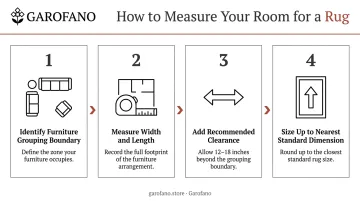
Before you order, use masking tape on the floor to map out the rug's footprint. This is the most reliable way to visualize scale in an actual room and prevents expensive returns. Ten minutes with tape on the floor will tell you more than any room render.
For rooms furnished with large-scale or made-to-order pieces (a custom sectional, a substantial dining table) confirm the furniture's exact dimensions before finalizing the rug. The two decisions are interdependent, and the rug size should respond to confirmed measurements, not estimated ones.
Common Large Rug Sizing Mistakes
Most sizing errors come down to the same three missteps — and each one is avoidable.
Buying too small. Choosing a 5x7 or 6x9 to save cost in a room that needs an 8x10 or 9x12 is the most common mistake. The undersized rug fragments the layout visually and makes the room feel smaller. A rug that fails its anchoring function hasn't saved money — it's spent it on the wrong size.
Ignoring wall clearance. Placing a rug too close to the walls eliminates the visual breathing room that creates spaciousness. The standard 18–24 inch border of exposed floor between rug edge and wall isn't arbitrary; it's a proportion principle. Architectural Digest cites a minimum of 12 inches, but 18–24 inches is the widely accepted standard for larger rooms.
Misreading labeled dimensions. Rug labels — particularly on machine-made pieces — may not reflect the true cut size. A labeled "9x12" can measure closer to 8'6" x 11'6" after production variation and post-shipping settling. Always request verified dimensions in feet and inches before sizing to a specific furniture footprint. For handmade rugs, manufacturer tolerances of ±3 inches are not uncommon.
Frequently Asked Questions
What are standard sizes for large rugs?
The most commonly available large rug sizes are 8x10 ft (244x305 cm), 9x12 ft (274x366 cm), 10x14 ft (305x427 cm), and 12x15 ft (366x457 cm). Anything 8x10 and above is generally considered a large rug, though terminology varies by retailer.
Is a 10x14 rug too big?
A 10x14 is not inherently too big — it's the appropriate size for large living rooms, open-plan zones, or formal dining spaces seating eight or more. Room dimensions and furniture footprint determine fit; the rug size alone doesn't.
What is the largest size rug I can buy?
The largest standard retail size is typically 12x15 ft, with 12x18 ft available through specialist retailers like Rugs Direct. Palace-scale and fully custom sizes beyond 20 ft exist for grand residential or commercial spaces, available through bespoke manufacturers and specialty dealers.
What size rug do I need for a large living room?
An 8x10 works well for most large living rooms with a defined seating group. Step up to 9x12 for larger or floating furniture arrangements. For open-plan or great room settings, 10x14 or above is typically the appropriate choice.
How do I know if a rug is too large for my room?
A rug is too large if it leaves less than 18 inches of bare floor between its edges and the walls. Use the masking tape method on the floor to check before purchasing — map out the exact footprint and assess the border that remains.
Can you get a rug in a custom size?
Yes. Custom-sized rugs are available through specialty rug dealers and bespoke manufacturers. They're a practical solution for unusually proportioned rooms, open-plan spaces, or premium interiors where standard dimensions don't fit the layout.