Introduction
The best rooms don't happen by accident. They have a clear visual anchor — one piece that draws the eye the moment you walk in and sets the tone for everything around it.
That's what statement furniture is about. Not excess. Not buying the boldest or most expensive item in the store. It's about intentionality — choosing one piece whose form, scale, or material is strong enough to organize an entire room around it.
This guide covers the full picture: what actually qualifies a piece as a statement, the design characteristics that give it staying power, how to identify the right candidate for each room, and how to arrange everything else so it supports rather than competes. Start with the definition, and the styling decisions follow naturally.
Key Takeaways
- A statement piece earns its status through proportion, silhouette, and material quality — not price or boldness
- Every room needs one clear visual anchor; multiple focal points create visual tension, not character
- Scale verification before purchase is non-negotiable: tape the footprint on the floor first
- Supporting pieces should respond to the statement piece, not compete with it
- Timeless silhouettes outlast trends because their impact is rooted in design logic, not novelty
What Is a Statement Furniture Piece?
A statement furniture piece is a single, intentionally selected item that functions as the visual focal point of a room. It commands attention through its form, scale, silhouette, or material — not through decoration layered on top of it. It must also be functional furniture — which separates it from accent decor like art, lighting, or rugs that attract attention without organizing the space.
The Role It Plays in a Room
In any well-designed room, there's a hierarchy: one dominant element that anchors the eye, with everything else arranged in response to it. The statement piece sits at the top of that hierarchy. Without one, rooms feel directionless — full of furniture but lacking a sense of organization or intention. With the right one, the entire space gains coherence without any single element needing to work too hard.
Architectural Digest notes that a single large, sculptural sofa can make a small living room feel more open and cohesive — not more crowded — precisely because it gives the eye one place to settle.
What It Is Not
A statement piece is not simply the most expensive item in the room. And it's not the piece with the boldest color for its own sake. A piece earns that status through considered design: refined proportions, a distinctive silhouette, or a material that commands presence while remaining in harmony with the space around it.
There's also a meaningful difference between a trend-driven statement and a timeless one. Three pieces illustrate the point:
- Kagan Freeform Sofa (1950) — still in production, still immediately recognizable
- Saarinen Pedestal Table (1957) — a single sculptural idea executed without compromise
- Wegner Wishbone Chair (1949) — form and function resolved so completely it needed no revision
Their staying power comes from design logic — a clear functional idea expressed through coherent form — not from what was fashionable at the time.
That design logic has a practical consequence: when one piece in a room is clearly well-resolved, the eye extends that judgment to everything around it. Investing in a single strong piece consistently returns more visual impact than spreading the same budget across several average ones.
The Hallmarks of a Great Statement Piece
Scale and Proportion
Scale is where most people get it wrong. A piece that is technically beautiful but wrong in size for its room will undermine the space rather than elevate it.
House Beautiful recommends recording furniture dimensions, doorways, stairwells, and ceiling heights before committing — and using blue painter's tape to outline the footprint on the floor. This simple step prevents the most common and costly scale mistakes.
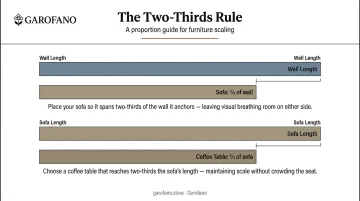
The Apartment Therapy Two-Thirds Rule offers a useful rule of thumb: a sofa generally works best at around two-thirds the length of the wall behind it. A coffee table should be roughly two-thirds the length of the sofa.
Neither measurement is a fixed rule, but both reflect the proportional thinking that separates an anchoring piece from one that simply looks out of place.
Silhouette and Form
An architecturally strong silhouette: a curved sofa back, a sculptural dining table base, an exposed frame chair with geometric precision. Each is one of the clearest signals that a piece intends to be noticed. The best silhouettes are legible from multiple angles, not just head-on.
Garofano's design philosophy treats silhouette as the primary tool of presence. The Eurotas sofa reads as a single sculpted gesture from across the room: its wraparound arms and recessed backrest form one continuous, composed shape rather than a collection of parts.
The Achaia follows the same logic, with rounded arms that flow into the backrest without interruption. That coherence — form resolving cleanly into form — is what separates a genuine statement from a piece that merely has interesting details.
Materiality and Finish
Material can be just as statement-making as shape. Stone, solid wood grain, rich upholstery, and elevated metal finishes all communicate design intention at a glance.
Some pieces in Garofano's collection make material the primary design driver. The Vulcano dining table's continuous marble top, kept deliberately thin at 0.8 inches, puts the veining and depth of the stone at the center of the room without visual interference. The Avola coffee tables use amber glass that catches and reflects light in ways that make the piece sculptural as much as functional. In both cases, material selection carries the design statement — supporting furniture simply needs to respond to it.
Color and Texture
Where materiality shapes structure, color and texture shape mood — but both work as amplifiers, not foundations. A deep emerald velvet sofa or a warm bouclé accent chair can heighten a piece's presence considerably. But the most enduring statement pieces would still hold their ground in a neutral finish — their presence comes from form and proportion first.
The practical implication: when evaluating a potential statement piece, imagine it in a plain linen. If it still commands the room, it's a genuine statement. If it relies entirely on its color to do the work, it may date faster than you expect.
Statement Furniture by Room
Each room has a natural candidate — the piece that controls the largest functional and visual zone.
| Room | Primary Candidate | What Makes It Work |
|---|---|---|
| Living room | Sofa or accent chair | Distinctive silhouette, rich upholstery, or architectural frame |
| Dining room | Table or dining chairs | Sculptural base, stone top, or architectural chair profile |
| Bedroom | Bed frame or headboard | Upholstered presence, paneled form, refined detailing |
| Entryway | Console or occasional piece | Sculptural silhouette or distinctive material at the sightline |
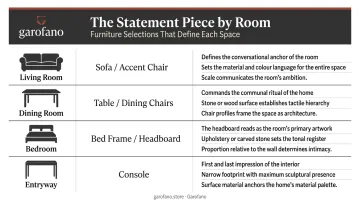
One rule that holds across all rooms: each space should have only one clear statement piece. Supporting furniture should complement — in material, tone, or proportion — without competing. ELLE Decor warns that too many "special" pieces make a room feel like it's shouting. The eye doesn't know where to settle, and the room reads as chaotic rather than designed.
Living Room
The sofa is the largest piece in most living rooms and the natural statement candidate. What makes it a statement: a distinctive silhouette (curved back, low-slung form, channel-stitched surface), a rich upholstery, or an elevated material.
An accent chair with a strong form can also serve this role when the sofa is kept more neutral — useful for anyone who wants flexibility to change the room's direction later without replacing the largest piece.
Dining Room
The dining table is an obvious focal point, but dining chairs can do the work too. A set of chairs with an architectural profile — a distinctive upholstery or exposed frame — adds visual rhythm across the table that a single object can't achieve. Architectural Digest's dining chair selections are organized explicitly around sculptural, surprising profiles for this reason.
Bedroom
In a bedroom, the bed is architecturally dominant and the most logical anchor. A headboard with genuine presence — upholstered in a rich fabric, designed with height and structure — sets the room's tone before anything else is considered.
House Beautiful identifies the headboard as one of a bedroom's primary focal points, with upholstery, contrasting piping, and paneled geometry as the main tools for building presence. Unlike the living or dining room, the bedroom's statement quality should feel grounding rather than dramatic.
Entryway
A console table with a sculptural silhouette or a distinctive material grounds the entry and communicates the home's aesthetic before a guest has moved further inside. It's where the design intention of a space becomes visible — and a well-chosen piece makes that first impression deliberate.
How to Choose and Style a Statement Piece
Choosing: Start Here
Before selecting, define the room's intended mood. Refined and serene? Warm and inviting? Architecturally bold? A piece that fights the room's existing character will always feel forced, regardless of its individual quality.
Three questions worth asking before committing:
- Does the form feel considered, or just current? Proportion and silhouette should be doing the heavy lifting. If the piece's appeal depends entirely on what's trending, it will date.
- Does the scale work in the actual room? Measure the footprint. Check ceiling height, circulation paths, and sightlines. A technically beautiful piece at the wrong scale undermines the space.
- Can the finish be specified? Made-to-order options — like those available through Garofano's collection with 18–20 week lead times — allow buyers to select materials and finishes that suit the long-term character of the space rather than defaulting to whatever's in stock.
Styling: Building Around It
Once the statement piece is placed, everything else serves the composition.
Give it room to breathe. Surrounding a statement piece with too much competing furniture is one of the most common errors. Negative space isn't emptiness — it's what allows the focal piece to register. Space around a well-chosen anchor makes a room feel larger, not sparser.
Build in dialogue, not duplication. Supporting furniture, textiles, and finishes should respond to the statement piece rather than replicate it. The goal is cohesion without uniformity — echoing a material, picking up a tone from the upholstery, or contrasting intentionally in texture.
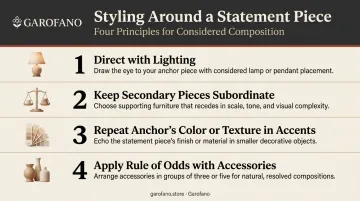
Four principles that hold across most spaces:
- Place lighting to direct the eye — a floor lamp near a statement chair, a pendant above a sculptural dining table — without adding a second focal point
- Keep secondary pieces subordinate in visual weight; they should recede, not compete
- Repeat the anchor's color or texture in smaller accents rather than duplicating the piece itself
- Apply the Rule of Odds with accessories, but only when the grouping defers to the furniture anchor
Common Mistakes to Avoid
- Too many statement pieces. Two items of equal visual weight in one room create competition, not character. One piece should clearly dominate; others can be bold as long as the hierarchy is unambiguous.
- Choosing for trend, not longevity. Trend-driven pieces date quickly and feel like mistakes. Choose pieces whose proportions and materials hold up as well in ten years as they do today.
- Getting scale wrong. A piece too small loses its statement quality entirely. A piece too large overpowers the room and interrupts flow. Measure carefully, tape the footprint on the floor, and confirm the dimensions before purchasing.
Frequently Asked Questions
What is a statement piece of furniture?
A statement piece is a single, intentionally selected furniture item that serves as the visual focal point of a room. It commands attention through its form, scale, silhouette, or material — not through decoration alone — and also functions as usable furniture that organizes the space around it.
How do you find a statement piece?
Start by identifying the room's dominant sightline and its intended mood. Then look for a piece whose proportion and material feel considered and enduring — prioritizing timeless silhouette over current trend. If it would still command the room in a neutral finish, it's a genuine statement.
What is the 2-3 rule for furniture?
The Two-Thirds Rule is a proportion guide: a sofa generally works best at around two-thirds the length of the wall behind it, and a coffee table at around two-thirds the sofa's length. It's a flexible heuristic, not a fixed standard — but it keeps arrangements feeling scaled rather than accidental.
What is the Rule of Odds in decorating?
The Rule of Odds holds that grouping decorative objects in odd numbers — three, five, seven — creates more visual engagement than even groupings. When a statement piece anchors the room, accessory groupings should complement it, not compete with it.
How many statement pieces should a room have?
One. Multiple focal points of equal visual weight create tension and dilute the impact of each. Bold supporting pieces can coexist with the anchor, but the hierarchy should always be clear — one piece leads, everything else responds.
Can a sofa be a statement piece?
Yes — and it's one of the most effective options in a living room. A sofa with a distinctive silhouette, a rich upholstery color, or a strong architectural form naturally commands the space. Its scale alone makes it the most likely anchor candidate in most living rooms.