Still, plenty of homeowners and designers hesitate. Will dark brown feel dated? Heavy? Hard to style with anything but beige?
Those fears are outdated. This guide breaks down why dark brown works, the color pairings that make it sing (including the 3-color rule), room-by-room styling advice, and how to spot furniture built to actually last.
Key Takeaways
- Dark brown is a warm, timeless neutral that pairs with earthy, cool, or metallic accents
- The 3-color rule (dominant, secondary, accent) keeps dark brown grounding a room instead of swallowing it
- Lighting, rugs, and wall tone determine whether dark brown reads as cozy or cave-like
- Construction quality shows up faster on dark finishes, so check joinery, veneers, and hardware before you buy
Why Dark Brown Furniture Works in Interior Design
Dark brown works because it functions as a warm neutral. It grounds a room the way black or charcoal gray does, but without the coldness. Wood grain and leather texture add organic warmth that flat black simply can't replicate.
There's also a practical case for it. Dark brown upholstery and wood tones camouflage everyday life:
- Water rings and light scuffs disappear into the grain
- Pet hair and minor stains blend rather than announce themselves
- High-traffic areas (think hospitality lobbies or family living rooms) stay looking sharp longer between deep cleans
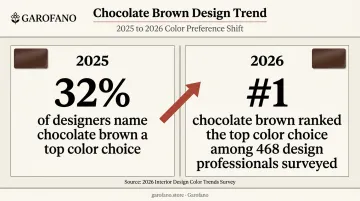
That durability-meets-style combination is a big reason designers keep returning to it. A 1stDibs survey of 468 design professionals ranked chocolate brown the top color choice for 2026. That's a sharp jump from the year before, when just 32% of a separate group of 643 designers named it a top pick (1stDibs 2026 Designer Survey). It signals a real shift in what clients are asking for.
Psychologically, brown carries associations with stability, comfort, and quiet sophistication. Designers lean on that to make sprawling, open-plan rooms feel intimate rather than cavernous. A single substantial dark brown piece, like a sectional or a large dining table, can visually "anchor" a room that would otherwise feel adrift.
Dark brown works across categories too. Sofas, dining tables, cabinetry, bed frames, occasional tables — it shows up as a foundation choice rather than a passing trend, reappearing season after season regardless of what else is trending.
Is Dark Brown Furniture Still in Style?
Yes, more than it's been in over a decade. After years of all-gray and all-white minimalism, designers are actively pushing back.
Architectural Digest's 2025 retrospective called dark woods a defining material of the year, with designer Susannah Holmberg noting that light wood had become overused as clients gravitated toward richer, darker timbers (AD, "Are Dark Woods Making a Comeback?"). Designer Jennifer Davis went further, telling AD that the all-white living room was "definitely stepping aside" for earth tones, chocolate included. This shift isn't just about aesthetics; it reflects a desire for interiors that feel warm and grounded rather than sterile.
The Color Pairing Guide for Dark Brown Furniture
Dark brown is one of the easiest tones to build a palette around, once you understand its undertones. Since brown is essentially a low-saturation orange, it has natural relationships with several color families.
What Colors Look Good with Dark Brown Furniture
- Neutrals (cream, ivory, taupe, warm white) lighten a dark brown piece without competing with it, giving a heavy sofa or table the breathing room it needs.
- Earthy tones (olive green, rust, terracotta, mustard) share undertones with brown, keeping the whole room cohesive rather than color-blocked.
- Cool contrasts (navy, forest green, slate blue) create moody, dramatic sophistication. Blue's complementary relationship to brown's orange base gives this pairing genuine color-theory backing, not just visual appeal.
- Metallics (brass, gold, bronze) work best in small doses. Think lighting fixtures, drawer pulls, or picture frames as a finishing touch rather than a dominant material.
Understanding the 3 Color Rule in Interior Design
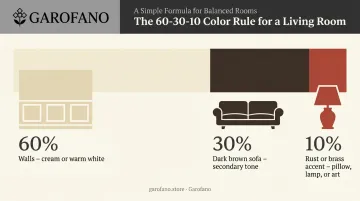
Choosing the right colors is only half the equation, proportion matters just as much. The 60-30-10 rule is the simplest framework for balancing a dark brown piece so it anchors a room instead of overwhelming it: 60% dominant color, 30% secondary color, 10% accent (House Beautiful, "The 60-30-10 Color Rule").
Here's how that plays out in a real living room:
- Walls at 60%: cream or warm white as the dominant backdrop
- Dark brown sofa at 30%: the secondary tone that grounds the seating area
- Rust or brass accent at 10%: a throw pillow, a lamp base, or a piece of art
If the furniture is larger or the room is smaller, dark brown can shift toward the 60% dominant share. The math flexes with scale, but the principle stays: let one tone lead, one support, and one punctuate.
Styling Dark Brown Furniture by Room
Different rooms put different demands on dark brown pieces. What works in a sun-drenched living room can feel oppressive in a windowless bedroom.
Living Room
Choose a rug in a lighter tone with warm brown undertones rather than a stark white one, which can look jarring against deep wood or leather. For walls, you have two directions:
- Light neutral for contrast and an airy feel
- Warm greige or taupe for a soft, layered look that still reads neutral
- Deep black or forest green for a moodier, more editorial look
Layer pillows and throws in varied textures (bouclé, linen, wool) to soften the visual weight of a large dark sofa or sectional.
Bedroom
A dark brown bed frame or dresser needs soft bedding tones to avoid a cave-like feel. Stick with warm whites, blush, or sage on the textiles, and skip cool-white overhead lighting in favor of warmer bulb temperatures. Layered lighting (bedside lamps plus a soft overhead source) keeps the room from feeling flat once the sun goes down.
Dining Room and Home Office
Dark brown tables and cabinetry create a quiet-luxury feel when paired with brass hardware, glass, or stone surfaces. This pairing works equally well in a residential dining room or a boutique hospitality setting, where the goal is understated confidence rather than ornate detail.
For dining rooms specifically, size the rug to extend at least 24 inches beyond the table on all sides, so chairs stay on the rug even when pulled out.
Garofano's approach to this kind of styling shows up in pieces like the Aria Dining Accent Chair, which pairs dark-finished timber legs with brushed brass or satin gold ferrules — a small detail that does a lot of the "quiet luxury" work described above.
Design Styles That Complement Dark Brown Furniture
Dark brown isn't locked into one aesthetic. It adapts across several design languages, each interpreting it a little differently.
- Rustic and modern farmhouse: pairs naturally with reclaimed wood, stone, and heavier textiles like wool and linen
- Contemporary and Italian-inspired minimalism: favors clean silhouettes and refined proportions over ornate carving, letting the wood or leather tone speak for itself
- Traditional: leans into rich dark-wood finishes like cherry, walnut, and chestnut, often with molding and symmetry
- Industrial: patinated wood and weathered leather sit comfortably against exposed brick and steel
- Eclectic: mixes vintage dark wood pieces with newer finds, often against a gallery wall or layered textiles
Garofano's collection leans into that second category. Pieces like the Eurotas sofa show this approach: a low, horizontal profile and integrated upholstered base, with no unnecessary detailing. That restraint is what makes a dark, substantial piece feel elevated rather than heavy.
Choosing Quality Dark Brown Furniture That Lasts
Here's something most buyers don't think about until it's too late: dark finishes are far less forgiving than light ones. Uneven staining, cheap veneer seams, and inconsistent leather grain all show up more obviously against a dark brown surface than they would on a pale oak or a light gray fabric.
That makes construction quality worth checking before you buy, not after.
What to inspect:
- Solid wood vs. veneer: veneer isn't inferior, but it needs a stable substrate and clean edge finishing to prevent peeling
- Leather grade: full-grain leather shows natural hide texture; corrected-grain leather is buffed smooth and can look artificial in dark tones
- Joinery and frame construction: look for kiln-dried hardwood frames and reinforced joints, not stapled or glued corners
- Finish consistency: run your hand along vertical edges — drips or rough patches show more on dark stains than light ones
This is where Garofano's made-to-order model helps. Pieces like the Methoni sectional, in rich brown tufted leather, and the Laconia modular sofa, in warm cognac leather with dark wood accents, are built to order rather than mass-produced and warehoused.
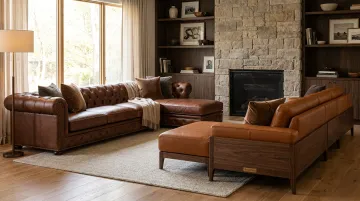
That process leaves room for consistency checks on finish and stitching before a piece ships. Combined with white-glove delivery, it lowers the odds of a dark brown piece revealing inconsistencies once it's in your living room, under your own lighting.
Garofano's broader value proposition, Italian-inspired design at a price point without inflated retail markup, matters more in dark tones, since the finish quality is the first thing anyone notices walking into the room.
Common Mistakes to Avoid with Dark Brown Furniture
Even a well-chosen dark brown piece can go wrong with the wrong setup. Three mistakes come up constantly:
- Overloading a small room. Multiple large dark pieces without enough light contrast make a room feel like it's shrinking. Balance one dark anchor piece with lighter walls or flooring.
- Skipping layered lighting. A single overhead fixture flattens dark brown furniture into a heavy silhouette once the sun goes down. Add table lamps, floor lamps, or sconces at varying heights to restore depth.
- Ignoring texture variation. All-smooth leather or all-matte wood flattens a room's visual depth. Mix in bouclé, linen, or a wool-blend rug so the eye has somewhere to travel.
Frequently Asked Questions
What colors look good with dark brown furniture?
Neutrals like cream and taupe soften it, earthy tones like rust and olive create cohesion, cool tones like navy add drama, and brass or gold accents finish the look in small doses.
What is the 3 color rule in interior design?
It's the 60-30-10 principle: 60% dominant color (usually walls), 30% secondary color (often the furniture), and 10% accent color for punctuation like pillows or lighting.
Is dark brown furniture in style?
Yes. Designers are moving away from all-gray and all-white minimalism toward warmer, deeper tones, and chocolate brown has become one of the go-to choices for adding richness without losing sophistication.
What wall color goes best with dark brown furniture?
Light neutrals like cream or warm white create airy contrast, while deep green or black walls create a moodier, more dramatic pairing. Both work depending on the room's natural light.
Does dark brown furniture make a room feel smaller?
It can, especially in low-light rooms with multiple large pieces. Balancing it with light walls, layered lighting, and lighter textiles prevents that heavy, closed-in feeling.
Can you mix different shades of brown furniture in the same room?
Yes, as long as the undertones match (warm with warm, cool with cool) and the textures vary. A mix of matte wood and leather, for instance, keeps it from looking mismatched.