Introduction
The most enduring interiors share something that rarely appears on a mood board: they draw from the physical world. Not through novelty or seasonal styling, but through materials that carry genuine weight, texture, and character — wood, stone, linen, rattan, clay. A room built from these materials doesn't just photograph well. It feels right to live in — and that distinction matters more than most design advice acknowledges.
Research from a 2018 randomized study found that brief exposure to biophilic interior environments was associated with measurably lower blood pressure and 14% better short-term memory performance — evidence that our response to natural materials isn't aesthetic preference alone. It's physiological.
That's the starting point for everything that follows. From the 70/30 and 3-5-7 frameworks to room-by-room application, this guide works through what each natural material does — and how to use it with enough intention that the result reads as considered, not collected.
Key Takeaways
- Natural elements extend well beyond plants — marble, stone, rattan, and linen belong in furniture, flooring, and walls
- Biophilic design has measurable effects on stress and cognition, not just visual appeal
- The 70/30 and 3-5-7 rules are reliable heuristics for layering natural elements without visual clutter
- Refined natural interiors pair raw texture with clean lines and deliberate proportions
- One substantial anchor piece (a marble-top table, a stone console) does more for a room than a dozen small accents
What Is Biophilic Design and Why It Belongs in Your Home
Biophilic design is the intentional integration of natural elements — materials, light, color, texture, and pattern — into interior spaces to maintain a human connection to the natural world. It operates at two levels:
- Direct experience: actual plants, natural light, water features, living materials
- Indirect experience: natural materials (wood, stone, clay), nature-inspired colors, organic shapes, surface patina
According to the EPA, Americans spend approximately 90% of their time indoors. When your environment is almost entirely built, the presence — or absence — of natural cues shapes mood, stress levels, and how a space actually feels to live in.
Beyond Trend: A Design Philosophy With Staying Power
Biophilic principles appear across centuries of architectural tradition, from the open courtyards of Roman houses to the timber and stone interiors of Japanese vernacular architecture. The current resurgence reflects a return to principles that have always shaped how people build spaces worth inhabiting.
Biophilic design as a philosophy means building a room's entire material and sensory logic around natural references. Using natural decor accents — a plant, a wooden bowl — applies the same principle at a lighter scale. This guide covers both, from quick additions to full room design.
The 10 Essential Natural Materials for Home Decor
Think of these as a material vocabulary. Each has its own visual weight, tactile quality, and design personality. Used well, they don't just decorate a room — they define it.
Structural Natural Materials
Wood, stone, and clay plaster form the architectural foundation of natural interiors.
- Wood (oak, walnut, ash, larch) brings warmth, grain variation, and a handcrafted quality. Most impactful as flooring, dining tables, or built-in cabinetry. Indoor walnut tends to lighten and develop honey tones over time, while white oak changes more slowly — its golden tone deepening gradually.
- Stone (honed limestone, granite, slate) introduces permanence and cool tactility. Works best as countertops, floors, and accent wall surfaces.
- Clay plaster creates matte, breathable wall surfaces with a soft organic quality. Clayworks documents its plaster as having roughly twice the vapor permeability of lime plaster — meaning it actively buffers humidity, making it a functional as well as aesthetic choice.
Marble occupies its own category. Its veining is entirely natural — no two slabs are identical — yet its finish positions it at the intersection of nature and luxury. It performs best on tabletops, countertops, and statement consoles, and pairs cleanly with warm-toned woods and brushed metals.
Woven and Fiber Natural Materials
These add lightness and a handcrafted quality that heavier structural materials cannot achieve alone.
| Material | Best Applications |
|---|---|
| Rattan | Chairs, pendants, occasional tables |
| Jute | Rugs (basket-weave, boucle constructions) |
| Seagrass | Area rugs, fitted carpets |
| Sisal | Stairs, hallways, high-traffic rugs |
| Linen | Upholstery, drapery, cushions |
| Bamboo | Wall cladding, accessories, furniture frames |
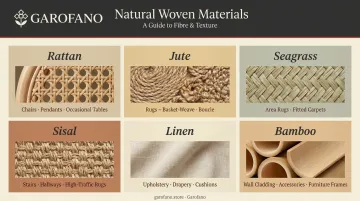
Natural fiber rugs — jute, sisal, seagrass — aren't ideal for wet areas or high-traffic zones. They stain when damp and are difficult to clean. Tighter weaves, sisal especially, hold up better in moderate-traffic areas.
Botanical and Organic Accent Materials
This is the decorative and tactile layer: the details that make a room feel lived-in rather than styled.
Living elements (plants, fresh-cut stems) introduce movement, color, and real biological presence. They require maintenance and are better suited to rooms where they'll get consistent care and light.
Preserved and foraged elements are lower-maintenance and work equally well in refined interiors. Good options include dried pampas grass, cotton stems, eucalyptus, seed pods, pinecones, driftwood, smooth stones, shells, pressed botanicals, and woven moss panels.
Eight accent materials worth keeping on hand:
- Dried eucalyptus stems in a tall vessel
- Smooth river stones in a stone or ceramic bowl
- A piece of driftwood as a sculptural object
- Pinecones grouped on a wooden tray
- Terracotta pots with herbs or trailing plants
- Dried pampas grass in an earthenware vase
- Woven seagrass baskets for storage and texture
- Pressed botanical frames as wall art
Design Rules for Incorporating Natural Elements
The most common mistake with natural materials is overuse: too many raw surfaces, too many organic textures, too many plants — until the room loses its sense of order. The rules below are the antidote.
The 70/30 Rule
The 70/30 rule is a flexible styling heuristic: roughly 70% of a room reflects the dominant design direction, and 30% introduces contrast or counterpoint. No precise counting required — designers apply it intuitively.
Applied to natural decor:
- Natural-dominant room: 70% warm woods, linen, earthy tones; 30% polished metal, lacquered surfaces, or solid upholstery in a clean neutral
- Contemporary room: 70% architectural, minimal; 30% natural — a stone coffee table, a jute rug, woven cushions — prevents the space from reading as clinical
The 30% is where tension lives, and tension is what makes a room interesting.
The 3-5-7 Rule
Objects are most visually engaging when grouped in odd numbers — 3, 5, or 7 — at varying heights. The asymmetry creates movement without feeling random.
In practice:
- Console vignette: a stone bowl, a dried stem arrangement in a ceramic vessel, a wooden object — three items at different heights
- Shelf composition: 5 items with deliberate height variation — a tall vessel, a mid-height sculptural object, a small stone, a book stack, a trailing plant
- Coffee table: 3 elements — a natural tray, a stone object, a single stem
The odd-number principle works because it's harder to read as forced or symmetrical. It doesn't mirror nature's own arrangements exactly — but it avoids the stiffness of even, paired groupings.
Mixing Natural Materials Without Visual Chaos
Four practical principles for layering multiple natural materials cohesively:
- Anchor with one dominant material — a wood floor, a stone surface, or a large-format natural fiber rug sets the primary reference point
- Limit active textures to 2-3 per area so each material registers clearly rather than competing
- Pair large-grain or rough surfaces (raw stone, heavy linen) with finer ones (smooth marble, tightly woven seagrass) to create scale contrast
- Let earth tones and muted naturals carry cohesion across different materials — no matching palette required
Balancing Natural Elements with Modern Design
All-natural rooms can feel heavy or unresolved without something man-made to create contrast. The most compelling interiors introduce at least one architectural counterpoint: concrete, lacquer, glass, or polished metal.
Reflective surfaces — brushed brass, lacquer, polished stone — attract the eye and sharpen the organic materials around them. A brass leg against a marble top, or a lacquered cabinet beside a rough-linen sofa, gives the natural elements something to push against.
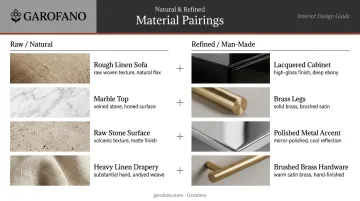
Let those pairings breathe against plain white walls or minimal cabinetry, and the tension between raw and refined does the work.
Incorporating Natural Elements Room by Room
The goal in each room differs: calm and restoration in bedrooms, warmth and social energy in living and dining spaces, freshness and material honesty in kitchens and bathrooms.
Living Room
The living room is the primary stage for natural material layering. Start with:
- A natural fiber rug (jute, sisal, or seagrass) as the compositional anchor
- Wood furniture — a coffee table or side tables, ideally a marble or stone-top piece with a warm timber base
- Linen or cotton upholstery on the sofa for breathable, tactile softness
- Botanical accents — a large-leafed plant, dried stems, a stone or wooden bowl — styled using the 3-5-7 rule on the coffee table
Dining Room
The dining room benefits from productive tension: a solid wood or marble-top table against rattan chairs, with metal pendants and tailored linen napkins pulling the refinement back in. The table is the single most important investment here.
Solid wood tables change color gradually with light and air exposure — walnut lightening toward honey, oak deepening slightly — which builds character over time. Marble stays fixed but develops visual depth with use.
Bedroom
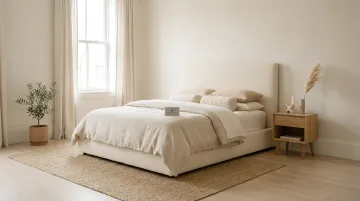
Bedrooms call for softer, quieter natural materials:
- Linen bedding for breathable, low-maintenance softness
- A jute or wool rug underfoot for warmth without visual weight
- Light wood furniture with clean proportions
Avoid overstimulating textures in the bedroom — heavily grained raw wood, rough stone — which disrupt the restful quality of the space. One dried botanical arrangement or a single potted plant is sufficient as a natural accent.
Bathroom and Kitchen
In bathrooms, stone surfaces (marble, travertine, limestone) elevate the material story beyond standard tile. Small natural accents read clearly in a pared-back context:
- A wooden tray or stone soap dish on the vanity
- Dried eucalyptus hung from a shower hook
- A linen hand towel for tactile contrast against hard surfaces
Note that marble and limestone are calcium-carbonate stones sensitive to acids; the Natural Stone Institute recommends neutral stone cleaners and thorough drying rather than acidic products.
In kitchens, wood cabinetry or a stone countertop serves as the structural natural anchor. Once that foundation is in place, smaller accents layer in naturally:
- Herbs in terracotta pots on the windowsill
- A woven fruit bowl on the counter
- A wooden cutting board displayed upright against the backsplash
Color Palettes and Textures Inspired by Nature
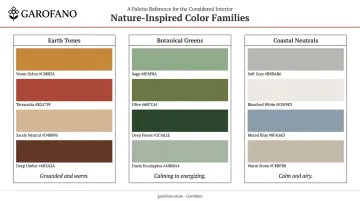
Nature-inspired color falls into three broad families:
- Earth tones — warm ochres, terracottas, sandy neutrals, deep umbers; evoke soil, clay, and dry vegetation
- Botanical greens — sage, olive, deep forest, dusty eucalyptus; these range from calming to energizing depending on saturation
- Coastal neutrals — soft greys, bleached whites, muted blues; quiet, cool, and expansive in feeling
Match your palette to the mood you're building:
- Earth tones — best for interiors meant to feel grounded and warm
- Botanical greens — work well in rooms with strong natural light
- Coastal neutrals — ideal where the goal is calm and visual airiness
Tonal layering is the technique that separates flat from rich: rather than introducing sharp color contrast, use multiple shades of the same earthy tone across walls, furnishings, and textiles. Think warm sand walls moving toward deep mahogany in the furniture — a continuous tonal progression rather than a color block.
In natural design, texture functions like color. A jute rug in an earthy tone reads differently than a flat-woven wool in the same hue because each surface handles light in its own way. In rooms built on neutrals, material texture becomes as important a tool as paint selection — it shifts with the time of day in ways that flat color simply cannot.
From Accents to Anchor Pieces: Elevating Natural Decor
Most people begin with accents — a plant here, a bowl there. The rooms that feel genuinely transformed are anchored by at least one substantial natural material piece. An anchor piece gives everything else permission to be simpler; it holds the compositional weight so the smaller elements don't have to work as hard.
Italian design has long understood that material is identity. The grain of a walnut frame, the cool surface of a travertine top, the structural logic of a marble slab are aesthetic decisions as much as functional ones.
Garofano's collection, built around refined proportions and honest materiality, offers exactly these kinds of anchor pieces: marble-top dining tables, stone consoles, and mixed stone-and-timber coffee tables that bring compositional grounding to a natural interior. The Consolle Lucca Travertino pairs a slim marble top with warm travertine-style ribbed column supports, functioning as both furniture and sculpture.
Four guidelines for selecting a natural material anchor piece:
- Choose a material that complements without matching existing textures. A marble top against a wood floor reads as contrast; against marble tile, it reads as repetition.
- Prioritize scale. An anchor piece should be proportionate to the room and not overshadowed by the accessories around it.
- Select materials that change well. Solid wood and natural stone don't degrade; they develop character that improves rather than diminishes the piece over time.
- Invest in construction quality. Natural material anchor pieces are meant to be permanent, not seasonal. The investment is in decades of use, not a single design moment.
Frequently Asked Questions
What are 10 natural materials used in home decor?
Wood, stone/marble, rattan, jute, linen, bamboo, seagrass, clay/plaster, sisal, and cork. Each serves a distinct role: wood and marble anchor furniture and surfaces; rattan, jute, and seagrass add handcrafted texture to rugs and accent pieces; linen and sisal soften upholstery and floors; bamboo, clay plaster, and cork work well for structural or wall applications.
What is the 70/30 rule in decorating?
About 70% of a room reflects its dominant design direction — material, style, or color — while 30% introduces deliberate contrast. In natural interiors, that 30% might be polished metal or lacquer; in contemporary rooms, it might be a stone table or woven rug that prevents the space from feeling sterile.
What is the 3-5-7 rule in interior design?
Decorative objects arranged in odd-number groupings of 3, 5, or 7 at varying heights create asymmetry and visual movement without feeling forced. In natural interiors, this might mean a coffee table vignette of three pieces at different heights — a tray, a stone object, and a single stem — arranged to feel considered rather than collected.
How do you mix natural materials without making a room look too rustic?
Balance raw textures (rough linen, stone, driftwood) with refined finishes — polished metal, smooth marble, lacquered surfaces. Apply the 70/30 rule to ensure at least some counterpoint to the organic elements. Anchor with clean-lined furniture so the natural materials read as a considered choice rather than an unedited collection.
What natural materials work best in a modern or contemporary home?
Marble, fine-grain oak, smooth honed limestone, and tightly woven linen or wool integrate most cleanly into modern schemes. These carry natural credentials without heavy texture or visual complexity — they bring warmth and material authenticity without disrupting architectural clarity.