This guide covers the defining principles of Italian style, its major historical expressions, the signature palette and materials that make these interiors recognizable, and practical room-by-room ideas for applying the look in a US home.
Key Takeaways
- Italian design is a living tradition: classical heritage and forward-thinking creativity held in deliberate balance
- Proportion, material quality, and restraint are the principles shared across all Italian design eras
- The Italian palette runs on warm neutrals and earthy mid-tones, anchored by limewash or Venetian plaster wall finishes
- Every room reads stronger with fewer, better pieces — clean silhouettes chosen for longevity, not trend cycles
- Furniture designed to work together as a collection produces the most convincing Italian-inspired interior
What Is Italian Interior Design?
Italian interior design isn't a single style you can point to and replicate. It's a discipline shaped by centuries of art, craft, and regional character — which is exactly why it has produced everything from stark Milanese minimalism to the ornate grandeur of Roman palazzo interiors.
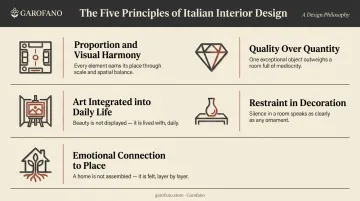
Across every regional expression and historical period, five principles hold:
- Proportion and visual harmony — rooms are composed, not decorated
- Quality over quantity — fewer objects, better materials
- Art integrated into daily life — not hung on walls as an afterthought
- Restraint in decoration — bella figura without clutter
- Emotional connection to place — interiors that feel rooted, not assembled
Regional Character, Unified Philosophy
Italy's geographic diversity produces interiors that share these principles but feel entirely different in atmosphere. Milanese interiors tend toward measured restraint — natural wood, stone, and a quieter palette. Tuscan farmhouses lean earthy and tactile, with terracotta as the dominant material note. Puglian spaces embrace warm stone, old brick, and sandy tones that reflect the landscape directly. Roman grandeur operates at a different scale entirely: frescoed ceilings, marble in multiple varieties, and monumental corridors.
For US homeowners, the practical takeaway is this: Italian-inspired design borrows this visual language — refined proportions, elevated finishes, curated restraint — without requiring access to centuries-old craft traditions or site-specific materials. The principles translate; the execution adapts.
That adaptability helps explain Italy's continued hold on global design. The Salone del Mobile.Milano drew 316,342 visitors from 167 countries in 2026, a 4.5% increase over the previous year — with 68% of attendees being international trade professionals. When two-thirds of the world's leading designers still travel to Milan each year to see what's next, the influence isn't historical. It's current.
The Major Styles of Italian Interior Design
Classical and Baroque Interiors
The Renaissance gave design its proportional grammar — human scale, mathematical harmony, and a deep debt to Vitruvius. Baroque interiors pushed that foundation toward opulence: frescoed ceilings, marble floors, gilded woodwork, and symmetry at every turn.
Contemporary designers don't reproduce these interiors wholesale. Instead, they extract one or two elements: a single antique console against a limewashed wall, or a coffered ceiling detail in an otherwise spare room. One well-chosen reference carries the historical weight without overwhelming the space.
Razionalismo and Modernist Foundations (1920s–1940s)
In 1926, seven young architects formed Gruppo 7, Italy's first organized modernist movement. They stripped away ornament in favor of clean tubular steel, functional simplicity, and an architecture that served life rather than displayed status. This movement planted the seed for Italy's later dominance in modernist furniture and industrial design. That foundation shaped the form language of nearly every Italian design object that came after.
Post-War Modernism and "Bel Design" (1950s–1970s)
The Italian economic miracle produced something remarkable: designers who treated everyday objects (a lamp, a sofa, a chair) as opportunities for cultural expression. Gio Ponti, who founded Domus magazine in 1928, spent decades advocating for a collaboration between industry and design that would elevate the made object. Achille Castiglioni approached design as research, finding beauty in function. Their generation created icons that still define what "Italian furniture" means.
The 1972 MoMA exhibition "Italy: The New Domestic Landscape" presented 180 objects and 11 commissioned environments, with curator Emilio Ambasz positioning Italy as the world's dominant force in product design. That institutional recognition cemented a reputation that has never fully left.
Memphis Group and Postmodern Design (1980s)
Ettore Sottsass founded the Memphis Group in December 1980, debuting the collection in 1981. It was a deliberate provocation: bold color, geometric pattern, neon, laminates, and irreverence toward modernist restraint. Sottsass described the designs as "dedicated to life, not to eternity." Memphis was polarizing, short-lived as a formal collective, and enormously influential. Its impact is still visible in maximalist interiors that treat color and pattern as primary design tools.
Contemporary Italian Design
Today's Italian aesthetic operates as a confident synthesis. Two studios illustrate the range:
- Lissoni & Partners works with natural wood, stone, and neutral restraint as art-framing tools. Their Dolomites apartment shows how material coherence outperforms decoration.
- Pelizzari Studio places heritage materials (travertine, Pietra Serena, timber beams) in dialogue with modern interventions, particularly in hospitality projects that have reshaped residential design thinking.
The throughline across all of it: proportion and material quality carry the room. When those are right, decoration becomes optional.
Signature Colors and Materials
The Italian Palette
Italian interiors favor layered, nuanced color over single accent walls. The palette typically moves through three registers:
- Warm neutrals for walls and plaster: ivory, travertine white, warm off-white
- Earthy mid-tones for upholstery and textiles: terracotta, sienna, warm taupe
- Deep anchors for statement pieces: forest green, navy, burgundy
Bold color tends to be confined to a single statement object — a velvet sofa in deep amber, a dining chair in a saturated tone — rather than applied to entire rooms. The restraint is deliberate: one saturated piece reads as intention; many read as noise.
Wall Finishes That Age Well
Flat paint is rarely the choice in an authentically Italian interior. Three finishes define the approach:
- Limewash — permeable, slightly variable, develops character over time
- Marmorino — lime putty combined with fine marble powder, documented in Venetian palaces from the 15th century
- Cocciopesto — lime with crushed ceramic material, originally a Roman hydraulic technique, now valued for its matte depth and texture
All three add dimension that flat paint cannot replicate. The wall finish, in this sense, is the first material layer — what everything placed against it either absorbs or reflects.
The Material Palette
The combination of materials — not any single one — creates the sensory warmth Italian interiors are known for:
| Material | Typical Application |
|---|---|
| Carrara and travertine marble | Floors, bathrooms, table surfaces |
| Solid walnut and oak | Cabinetry, furniture frames |
| Velvet and bouclé | Upholstery for sofas and chairs |
| Hand-glazed ceramic tile | Kitchen backsplashes, bathroom walls |
| Bronze or brushed brass | Hardware, lighting fixtures |
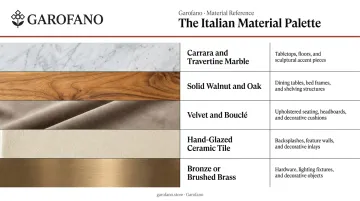
Pairing smooth marble with warm wood and soft textile creates the layered sensory experience that distinguishes Italian spaces from interiors that are merely expensive. How those materials read, though, depends entirely on what falls on them — which is where lighting becomes part of the design vocabulary.
Lighting as a Design Material
The Italian approach to lighting is sculptural and layered:
- Statement pendant — a chandelier treated as an object, not just a functional fixture
- Recessed ambient fill — discreet sources that support without competing
- Table lamps — placed to create intimate pools of warmth at eye level
Natural light is treated as a material in its own right. Large windows, interior shutters, and sheer drapes modulate it rather than block it — shaping how the room reads at different times of day.
Italian Interior Design Ideas Room by Room
Living Room
The Italian living room is composed around proportion. A sofa with a clean, structured silhouette anchors the seating zone. An area rug in a neutral or deep tone defines the space underfoot. One large-scale artwork or architectural mirror acts as the room's focal point — chosen for presence, not arranged for symmetry.
Garofano's sofa collection is built around this logic. The Corinthia ($4,900) offers a linear silhouette with layered arm detailing and slender brass legs — architectural clarity without stiffness. The Kalavryta ($12,500) works at a larger scale, with an integrated perimeter frame that contrasts a sculpted outer shell against soft upholstered seating. Both are available in bouclé, leather, or wool blends, and ship made-to-order in 18–20 weeks with white glove delivery.
Texture layering does the rest: velvet cushions against a linen sofa, a marble-top coffee table beside a warm wood console. The contrast between materials creates the sensory depth that makes an Italian living room feel considered without being overdone.
Bedroom
The Italian bedroom is restrained in a deliberate way — edited rather than sparse. The color palette connects to the rest of the home rather than veering into a separate scheme. Core elements tend to follow a consistent logic:
- Upholstered bed frame in a muted, grounded tone
- Bedside tables with refined hardware, not decorative excess
- Wall paneling or a subtle wallcovering for quiet depth
- Soft ambient lighting that avoids overhead harshness
Textile layering carries the warmth: linen sheets, a weighted throw, one tactile element like a velvet bolster. The preference is for quality and calm over pattern-heavy bedding sets that demand attention. The bedroom should feel like a continuation of the home's material conversation, not a departure from it.
Kitchen and Dining
The Italian kitchen holds elegance and function at the same level. A few recurring details define the aesthetic:
- Dark or warm-toned cabinetry paired with stone countertops
- Hand-glazed tile backsplashes referencing regional ceramic traditions
- Integrated appliances to preserve clean sight lines
- Warm brass or bronze hardware as a unifying thread across the space
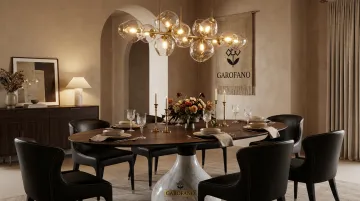
For dining, the table is a social centerpiece — often a substantial piece in solid wood or with a marble top, surrounded by upholstered chairs in a complementary fabric. Overhead lighting elevates the ritual: a sculptural pendant or chandelier that marks the dining zone as worthy of attention. In Italian interiors, how a room is furnished shapes how it gets used — and the dining room is where that principle shows most clearly.
How to Incorporate Italian Interior Design in Your Home
Start with proportion and restraint
Edit down rather than add more. Italian interiors succeed because every piece earns its place. Choosing fewer, better-quality furniture pieces with clean silhouettes produces more immediate impact than filling a room with trend-led accessories. That discipline — knowing what to leave out — is what gives Italian-inspired rooms their sense of ease.
Invest in material quality over decorative quantity
Upgrade key surfaces first — a marble or stone tabletop, Venetian plaster on a feature wall, a solid-wood furniture frame — as permanent investments that age well. Layer softer materials (velvet, linen, bouclé) through textiles, which can be updated more easily as priorities shift. The hierarchy matters: surfaces are permanent commitments, textiles are flexible ones.
Curate a cohesive collection
Mixing styles at random produces rooms that feel assembled rather than composed. Working with a design-led furniture house whose pieces are conceived to work together — consistent proportions, complementary finishes, a unified point of view — removes the complexity of sourcing across multiple vendors.
Garofano's collection is built specifically for this approach. Pieces share proportional logic and material sensibility across categories, from sofas and dining chairs to coffee tables and marble accent pieces. The made-to-order model — with options for upholstery, frame finish, and sizing — means the collection works around your space, not the other way around.
Frequently Asked Questions
What is Italian style interior design?
Italian interior design balances elegance, warmth, and refined proportion — blending classical heritage with modern creativity while prioritizing quality materials and visual harmony. The underlying belief is that a home should be both beautiful and deeply livable, not a showroom to be admired from a distance.
What are the colors for Italian interior walls?
Warm whites, ivories, and limewash or Venetian plaster finishes in warm neutrals define the Italian wall palette, with deeper earthy tones like taupe or sienna appearing in select rooms. The goal is visual continuity across the home, not bold accent walls that break the flow.
What is the 3-5-7 rule in interior design?
The 3-5-7 rule is a guideline for grouping decorative objects in odd numbers — three, five, or seven — to create visual rhythm and balance rather than visual clutter.
What furniture is typical in Italian interior design?
Upholstered sofas and armchairs with structured, clean-lined profiles; solid-wood dining tables; marble-top consoles and coffee tables; and beds with upholstered headboards. The common thread is refined proportions, quality materials, and elevated but restrained detailing — no unnecessary ornamentation.
How is Italian interior design different from other European styles?
Italian design occupies the middle ground between French ornate layering and Scandinavian austerity. It combines sensory warmth and material richness with clean lines and proportion-conscious restraint — spaces that feel luxurious and livable rather than decorative or deliberately spare.