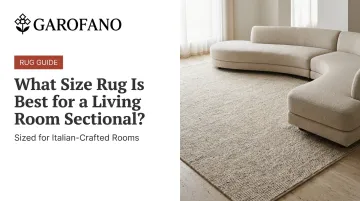
Standard sofa rug advice doesn't translate to sectionals. A regular sofa occupies floor space in one direction. A sectional occupies it in two or more simultaneously — which means shape and configuration matter just as much as overall length. An 8x10 rug that works beautifully under a straight sofa can look like an accent piece next to an L-shaped sectional.
This guide covers what actually works: size recommendations by sectional type, how to measure correctly, the three placement approaches and when to use each, and the style considerations that go beyond dimensions.
Key Takeaways
- Size up when in doubt — most sectionals need at least an 8'x10', and large or U-shaped configurations typically call for a 9'x12' or 10'x14'
- Sectional shape determines rug size more than length alone; always measure the full seating footprint
- The rug should extend 12–24 inches beyond the sectional on open sides to visually anchor the area
- At minimum, front legs should rest on the rug — all legs on is the most polished result
- Low-to-medium pile rugs work best under sectionals for even leg placement and a cleaner overall look
Why Rug Size Makes or Breaks a Sectional Setup
Under a sectional, a rug functions as the foundation of the entire seating zone — it defines the conversation area and signals that the arrangement was composed with intention, not just assembled piece by piece.
When the rug is correctly sized, the sectional feels grounded. The furniture belongs to the room. When the rug is too small, the sectional appears to float on bare floor, and every individual piece — no matter how well-made — looks like it arrived separately and never quite settled in.
Sectionals demand more rug coverage than straight sofas because they occupy floor area on two or more sides at once. Architectural Digest designers note that an undersized rug is the "biggest mistake" — it makes furniture appear oversized and creates visual disharmony.
A rug that anchors a three-seat sofa will often read as an undersized accent piece once a chaise or second arm enters the picture.
Sizing principles to follow:
- The rug's width should at minimum match the shorter side of the sectional
- Its length should extend comfortably past the longer side
- On open sides (not against a wall), 12–24 inches of rug should remain visible beyond the furniture
Getting these proportions right is the starting point — from there, the specific dimensions depend on sectional configuration and room size.
Rug Size Recommendations by Sectional Type
L-shaped, U-shaped, and chaise sectionals all occupy floor space differently. Applying one universal minimum to every configuration is where most people go wrong — a size that looks right on paper can look completely off in the room.
L-Shaped Sectionals
The rug needs to anchor both arms of the L, which means it must span the corner. Cover only one side, and the other arm floats — the sectional reads as two separate pieces rather than one cohesive arrangement.
Size guidance:
- 8'x10' for compact layouts
- 9'x12' for standard configurations
- 10'x14' for larger rooms or sectionals with wide arms
Orientation matters here: align the longer rug dimension with the longer arm of the sectional, and ensure the rug extends past the shorter arm by at least 12 inches. A rug that stops short of one arm undermines the entire anchoring effect.
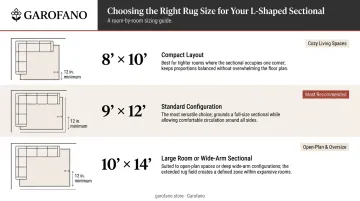
Many of Garofano's L-shaped sectionals — including the Kalavryta (135"W × 110"D) and the Gabbana — have substantial footprints that make 9'x12' the practical starting point, not the ceiling.
U-Shaped Sectionals
U-shaped sectionals wrap seating around three sides of a central space. The rug must fill the interior zone and reach under the front legs of all three sections. Size down here, and the center reads as empty floor rather than intentional negative space — the rug becomes the problem instead of the solution.
Size guidance:
- 9'x12' as the minimum for most U-shaped configurations
- 10'x14' or larger for rooms with generous proportions
According to Wayfair's placement guide, a U-shaped sectional needs at least 9'x12' and will often look better on 10'x14'. When in doubt between two sizes here, take the larger one.
Chaise Sectionals
A chaise sectional extends in one primary direction, but it still creates a two-zone footprint: the main sofa section and the chaise lounge. When the rug covers only the sofa portion, the chaise reads as an afterthought — spatially cut off from the rest of the seating zone.
Size guidance:
- 8'x10' for smaller chaise configurations
- 9'x12' for standard layouts
The rug must run beneath at least the front legs of both the sofa section and the chaise. Where the chaise terminates is where the rug should extend — not where the main sofa ends.
How to Measure Your Sectional for the Right Rug
Guessing from memory produces undersized rugs. Measuring takes ten minutes and prevents a return on a 9'x12' that weighs forty pounds.
Follow these steps:
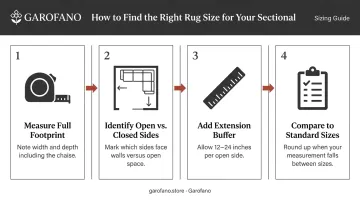
- Measure the full footprint — record the overall width and depth of the sectional, including any chaise extension, corner seat, or extended arms. This is the number that matters, not the length of the longest side alone.
- Identify open vs. closed sides — note which sides face into the room and which are against a wall. Only open sides need the extension buffer.
- Add your extension — add 12–24 inches to each open side. Rugs Direct recommends this range for sectional configurations; some retailers suggest a more conservative 8–12 inches, so treat it as a range and test in the actual room.
- Compare against standard sizes — check your target dimensions against the common tiers (8'x10', 9'x12', 10'x14'). If you land between two sizes, round up.
Before you order, use painter's tape to mark the candidate rug dimensions on the floor with the sectional in place. Before you order, use painter's tape to mark the candidate rug dimensions on the floor with the sectional in place. This single step reveals whether the chosen size reads correctly in the actual space — and avoids a costly return on a large area rug.
Also confirm the rug leaves at least 12–18 inches of exposed floor between its edge and the walls. If a 10'x14' would sit too close on any side, drop to a 9'x12' and adjust placement instead.
Three Placement Approaches and When to Use Each
All Legs on the Rug
Every leg of the sectional rests on the rug. This creates the most visually cohesive result — the seating zone feels like a room within a room, fully defined and deliberately composed.
Best suited for:
- Larger rooms where a 9'x12' or 10'x14' rug won't feel oversized
- Garofano sectionals with exposed slim metal legs or warm wood-toned base details — those architectural elements are meant to be seen in full, and a rug edge that bisects them disrupts the visual intent of the piece
Front Legs on the Rug
Only the front legs of the sectional sit on the rug; back legs remain on the floor. HORNE identifies this as the most common choice — it visually connects the rug and furniture while requiring less coverage than full placement.
Works well with:
- 8'x10' or 9'x12' rugs in standard-sized rooms
- Sectionals where the front edge spans a consistent, measurable width
One hard requirement: the rug must span the full width of the sectional at the front. A rug that only covers part of the front creates the same disconnected effect as one that's too small overall.
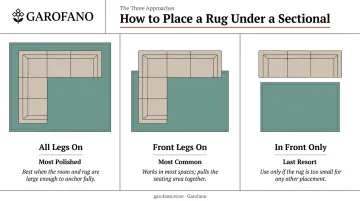
Rug Positioned in Front of the Sectional
The rug sits entirely in front of the sectional, typically centered under the coffee table, with no legs on it. This works only in very small spaces where even partial-leg placement isn't achievable — treat it as a last resort.
If you use this approach, the rug must sit close enough to the sectional to feel connected. A gap of more than a few inches between the front of the sofa and the rug's back edge makes the room feel fragmented. Works best with lower-profile sectional designs where the visual weight is carried by the furniture itself.
Beyond Size: Style, Color, and Texture Considerations
Color: Contrast Over Match
A rug that closely matches the sectional in tone causes both pieces to recede — they merge visually and neither reads clearly. Contrast works better: a lighter rug under a darker sectional (or vice versa) lets each piece register independently and adds depth to the room.
Garofano's sectional lineup is predominantly finished in warm neutrals, taupes, and earthy tones. A rug with a cooler or lighter tone (or one with a restrained geometric pattern) creates the separation needed for the sectional's silhouette to read clearly.
Pile Height: Keep It Low
Low-to-medium pile rugs perform better under sectionals for two practical reasons: furniture legs sit level on the floor, and the rug wears more evenly over time. Apartment Therapy recommends a low-pile wool or cotton flatweave specifically when sectional seating is partly on the rug, so furniture doesn't wobble on an uneven surface.
High-pile and shag rugs can cause legs to sink unevenly. With sectionals, that's compounded — multiple legs need to share a consistent plane, and any tilt compounds across the entire seating run.
Pattern: Support the Furniture, Don't Compete With It
For design-forward interiors built around sectionals with clean silhouettes and refined proportions (the kind of Italian-inspired aesthetic that defines Garofano's collection), the rug should support the furniture rather than compete with it.
A rug with a restrained pattern or tonal texture — soft geometry, quiet weave variation, a high-low construction that creates depth without competing for attention — allows the sectional's form and finish to remain the focal point.
Garofano's own rug collection, including pieces like the Calma, Trama, and Modena, is built around exactly this principle: rugs designed to complement rather than override the furniture around them.
Frequently Asked Questions
What size rug for a large sectional couch?
For sectionals over 120 inches, a 9'x12' is the standard minimum and a 10'x14' is appropriate for very large or U-shaped configurations. The rug should extend 12–24 inches beyond the open sides of the sectional — if a 9'x12' doesn't achieve that clearance, size up.
What kind of rug goes with a sectional?
Low-to-medium pile rugs in a tone that contrasts the sectional work best. Wool and flat-weave constructions hold up well under heavy furniture and stay visually clean — shag or high-pile options tend to sit unevenly under furniture legs and are best avoided.
How to place a large rug under a sectional?
Front-legs-on is the most practical approach for most large rugs — only the front legs rest on the rug while the back legs remain on the floor. For rugs 10'x14' and above, placing all legs on the rug is often achievable and reads as the most intentional, unified arrangement.
Should all legs of a sectional be on the rug?
All-legs-on is the most visually complete approach, but it requires a larger rug and a spacious room. Front-legs-on is equally acceptable — provided the rug is wide enough to span the full front edge of the sectional.
Can a rug be too big for a living room sectional?
A rug becomes too large when it leaves less than 12 inches between its edge and the wall on any side — at that point the room feels enclosed rather than defined. Within that boundary, sizing up is almost always the better choice.