Get the size right, and something shifts. The seating group reads as a cohesive zone. The room feels considered. The furniture looks like it belongs together rather than like it was arranged by coincidence.
This guide covers the standard living room rug sizes, the factors that determine which size works for a specific space, and the proportion-first approach professional designers apply — so you can make this decision with confidence rather than guesswork.
Key Takeaways
- A rug should frame the seating area — not fill the room wall-to-wall, and not sit isolated from the furniture
- 8x10 ft suits most mid-size living rooms; 9x12 ft is the better choice for larger rooms or floating furniture arrangements
- Measure the seating footprint first, then size up to the nearest standard — larger is almost always better
- Leave 12 to 18 inches of exposed floor between the rug edge and the wall on all sides
- Apply your chosen leg rule — all legs on or front legs only — consistently across every piece in the seating group
Why Rug Size Is the Most Critical Design Decision in Your Living Room
Most people treat the rug as decoration. Designers treat it as structure.
An undersized rug does more damage than most homeowners expect. When the rug is too small, furniture appears unrelated — as though each piece was placed independently rather than grouped with intent. The seating area loses definition, the room reads as unfinished, and the furniture can look oversized relative to the floor beneath it.
Architectural Digest notes that a too-small rug weakens proportion, makes furniture feel overly large, and can make the room feel smaller — and all three problems trace back to one sizing error.
The Rug as a Room Within the Room
Think of the rug as the boundary line of the living zone. It tells the eye where the seating conversation begins and ends. In an open-plan layout, that boundary becomes critical — without it, the living area dissolves into the surrounding space and loses its identity. Architectural Digest confirms that area rugs define zones in open layouts and anchor furniture into a unified grouping.
This is why Tai Ping creative director Jean-Pierre Tortil describes the rug as the room's "fifth wall" — it is a surface with the same compositional weight as the walls around it, just oriented horizontally.
Proportion Is a Principle
The rug-to-room relationship is not a matter of taste. It is a matter of proportion, and proportion either works or it does not. A correctly scaled rug does not just look better — it makes the entire room feel larger, more cohesive, and more considered. Get the size right, and nearly everything else in the room falls into place around it.
Living Room Rug Size Guide: Which Size Suits Your Space
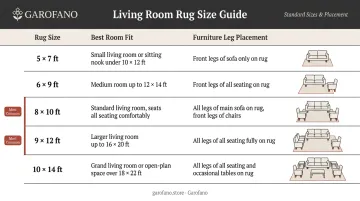
Standard living room rugs run from 5x7 ft to 10x14 ft. The right size depends on your room's dimensions, how the furniture is arranged, and the visual weight of the seating pieces. Here is how the most common sizes break down.
| Rug Size | Best For | Furniture Leg Placement |
|---|---|---|
| 5x7 ft | Small rooms, single sofa against wall | Front legs only |
| 6x9 ft | Rooms under ~11x13 ft | Front legs only |
| 8x10 ft | Standard mid-size rooms (~11x13 ft+) | Front legs preferred |
| 9x12 ft | Larger rooms, floating arrangements | All legs on rug |
| 10x14 ft | Grand or open-plan living rooms | All legs on rug |
8x10 ft — The Most Versatile Size
For a living room measuring roughly 11x13 ft or slightly larger, an 8x10 ft rug is the natural starting point. Pottery Barn and West Elm both recommend it for conventional sofa-based arrangements — typically a three-seat sofa with one or two accent chairs. The standard placement: front legs of the sofa and chairs on the rug, back legs off. This leaves a visible floor border of 12 to 18 inches around the perimeter and keeps the rug properly proportioned to the room.
Garofano's Argos sofa (98 inches wide) and Eurotas sofa (102 inches wide) both span just over 8 feet in width. Paired with accent chairs, either sofa's total seating footprint typically exceeds what an 8x10 can fully accommodate — making 9x12 the more practical choice for these pieces.
9x12 ft — For Larger Rooms and Floating Arrangements
When the sofa floats away from the wall, or when the room measures 12x18 ft or larger, a 9x12 ft rug becomes necessary. At this size, all furniture legs can sit fully on the rug — the most visually unified result. Pottery Barn's layout guides use 9x12 for sofas with chaises, sectionals, and two-armchair arrangements where complete coverage is the goal.
One rule that often forces this upgrade: the rug must extend at least 8 inches beyond the back of the sofa when furniture floats — not just the front. That single requirement is what most often pushes the selection from 8x10 to 9x12.
10x14 ft — Grand Rooms and Open-Plan Spaces
A 10x14 ft rug is for living rooms with substantial scale: formal sitting rooms, large open-concept floor plans, or rooms centered on an oversized sectional. At this size, all furniture pieces in the seating group sit fully on the rug, and 18 to 36 inches of exposed floor remains visible on all sides. Wayfair describes this size as appropriate for spacious family rooms with large sectionals, and Pottery Barn uses it for complete four-piece seating arrangements.
How to Choose the Right Living Room Rug Size
Standard size guidelines give you a starting point. These five factors get you to the right answer for your specific room.
Measure the Seating Area, Not the Room
The rug frames the furniture grouping, not the floor. Measure the full footprint of the seating arrangement — sofa, chairs, and coffee table combined — then select the nearest standard size up from those dimensions. That measurement is your anchor.
Before purchasing, use painter's tape to outline the proposed rug size on your actual floor. Designers David Thompson and CeCe Barfield both recommend this approach. It takes ten minutes and prevents the most common sizing mistake homeowners make.
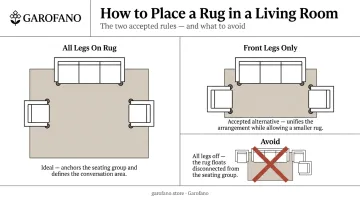
The Furniture Legs Rule: Consistency Is Everything
Two placements are accepted:
- All legs on the rug — the most unified and design-correct result, preferred in high-end interiors
- Front legs only on the rug — a workable compromise when the rug is slightly smaller than ideal
Both work. Keeping all legs completely off the rug is the one placement to avoid — it signals an accidental arrangement rather than an intentional one.
The more important rule is consistency. If the sofa's front legs are on the rug, every accent chair's front legs must also be on the rug. Inconsistency within the same seating group is immediately visible and undermines the entire composition.
Room Dimensions and Walkway Clearance
Leave 12 to 18 inches of exposed floor between the rug's edge and the surrounding walls. This visible border is what distinguishes an area rug from wall-to-wall carpet — it creates visual breathing room and keeps the rug reading as a design element rather than floor covering.
Walkway clearance matters too. Better Homes & Gardens recommends at least 30 inches of clear path for household walkways. The rug's size and placement should not obstruct natural traffic routes through the room.
Furniture Scale and Visual Weight
The rug must carry the visual weight of what sits on it. A large sectional or a pair of substantial upholstered chairs demands a rug that matches their presence — an undersized rug beneath heavy furniture makes the furniture look even more dominant and throws the room's proportions off entirely.
A lighter, more refined seating group needs proportional sizing in the other direction, or the rug overwhelms it.
Architectural Digest links undersized rugs directly to furniture appearing overly large. The imbalance between the floor surface and the pieces above it creates a visual imbalance that affects how the entire room reads.
Rug Orientation and Room Shape
A rectangular rug should align with the long axis of the room and the primary sofa direction. Orienting it against the room's natural lines creates visual conflict and makes the space feel smaller than it is.
Round rugs can work as a primary rug in compact, square living rooms or intimate vignettes. For most standard rectangular living rooms, a rectangular rug oriented with the room remains the default and the correct choice.
Common Living Room Rug Sizing Mistakes to Avoid
Three mistakes account for most rug sizing failures:
- Sizing down to save money. A 5x7 or 6x9 rug costs less upfront, but it fragments the seating area and makes the room read as smaller and unresolved. The incremental cost of sizing up is almost always worth it.
- Buying the rug before the furniture layout is set. The layout determines the seating footprint, and the seating footprint determines the rug. A rug selected before the arrangement is finalized will almost always be the wrong size.
- Applying the same rule to wall-backed and floating sofas. A sofa against a wall only needs the rug to extend at least one foot underneath it — the space behind is never visible. A floating sofa is different: the rug must extend at least 8 inches behind the sofa's back legs, which typically means moving up one full size.
How Garofano Approaches Proportion and Scale in the Living Room
At Garofano, proportion is not an afterthought. The Italian design heritage the collection is rooted in treats each object in a room as part of a coherent proportional hierarchy — and the rug is the layer that makes that hierarchy visible on the floor plane.
The Garofano living room collection reflects this thinking in the furniture itself. The Argos sofa (98 inches wide, 38 inches deep) and the Eurotas sofa (102 inches wide, 40 inches deep) share a low, horizontal profile that was designed to anchor a room compositionally, not just fill it. Both pieces occupy substantial floor space, which means their seating footprint — combined with accent chairs — typically calls for a 9x12 ft rug at minimum to maintain proper proportion.
With Garofano's exact furniture dimensions available at the point of purchase, the sizing calculation becomes precise rather than approximate. A general rule: the rug should extend at least 6 to 8 inches beyond the sofa on each side. For the 98-inch Argos, that means a minimum rug width of 110 to 114 inches — pointing to a 9x12 ft or 10x14 ft selection depending on the room.
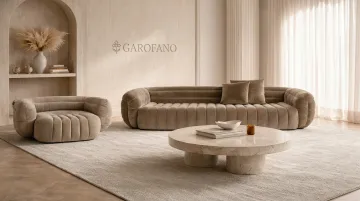
The rug is often the last decision made in a living room, but it affects how every decision before it reads. A correctly sized rug doesn't just fill the floor — it confirms the proportions of everything above it. Explore Garofano's living room collection to see how the furniture dimensions, silhouettes, and finishes inform the rug selection from the start.
Frequently Asked Questions
What is a good size for a living room rug?
For most standard living rooms, an 8x10 ft rug is the most practical starting point, with 9x12 ft being the better choice for larger rooms or when the furniture floats away from the wall. Always size to the seating footprint, not the full room dimensions.
Is an 8x10 rug big enough for a living room?
An 8x10 ft rug works well in rooms measuring around 11x13 ft with a conventional sofa-and-chairs arrangement using front-legs-only placement. In larger rooms, or when all furniture legs need to sit fully on the rug, a 9x12 ft is the better fit.
Should all furniture legs be on the living room rug?
All legs on the rug is the ideal arrangement for visual unity, but front legs only is an accepted alternative when the rug is slightly smaller. Whichever approach you choose, apply it consistently to every seating piece in the group.
How do I measure my living room for a rug?
Measure the combined footprint of the full seating arrangement — sofa, chairs, and coffee table — then select the nearest standard rug size up from those dimensions. Use painter's tape on the floor to visualize the actual size before purchasing.
What size rug do I need for a large open-plan living room?
Open-plan areas typically require a 9x12 ft or 10x14 ft rug to visually anchor the living zone and separate it from adjacent spaces. The entire seating group should sit within the rug's boundaries to keep the conversation area clearly defined.
Can a rug be too big for a living room?
Yes. A rug that reaches wall to wall loses its anchoring effect and reads as wall-to-wall carpeting. Aim to keep at least 12 to 18 inches of exposed floor visible on all sides.